
Wedding RSVP Attendance Calculator
Enter Your Guest List
Break down your guest list by relationship closeness for accurate predictions.
You’ve spent weeks perfecting the calligraphy on your wedding invitations is the formal request for a guest's presence at a marriage ceremony. You’ve mailed them out. Now comes the anxiety: who is actually coming? Overestimating means paying for empty chairs; underestimating means scrambling for extra plates. Getting this number right is less about crystal balls and more about understanding human behavior.
The short answer? Expect about 75% of your invited guests to say yes. But that’s an average, not a rule. Your actual number will swing wildly depending on whether you’re inviting childhood friends or distant cousins, and whether your wedding is in your hometown or a destination resort.
The Baseline: What Is a Normal RSVP Rate?
If you want a single number to start with, use 75%. This is the industry standard baseline for local weddings in North America and Europe. It assumes a mix of close family, friends, and some acquaintances.
However, "normal" changes based on the type of guest. Not all invites carry the same weight. Here is how different groups typically behave:
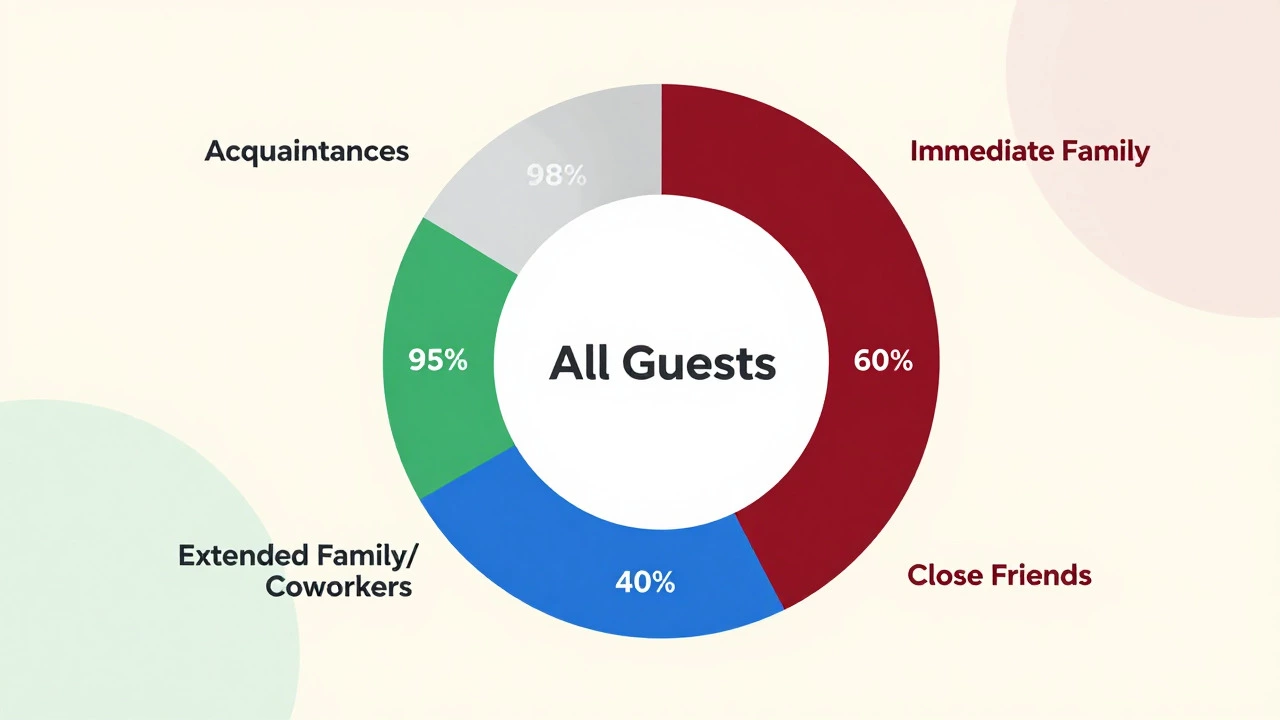
- Immediate Family & Bridesmaids/Groomsmen: 98-100%. Unless someone has a major life conflict (like a new baby or a job crisis), these people are showing up. Plan for full attendance here.
- Close Friends: 85-90%. These are the people you see regularly. They have made plans around your date months ago. Expect most of them to attend.
- Extended Family & Coworkers: 60-70%. This group includes second cousins, parents’ old college friends, and colleagues you don’t socialize with outside work. They might decline due to cost, travel, or simply low priority.
- Distant Acquaintances / "Plus-Ones": 40-50%. If you invite someone you haven’t seen in five years, or if you send a generic plus-one to a coworker, expect half to decline. Life gets in the way.
Don't treat your guest list as one big blob. Segment it. Calculate the expected attendance for each group separately, then add them up. This gives you a much sharper picture than applying a flat 75% to everyone.
Factors That Drastically Change Your Numbers
Your location, timing, and format act as multipliers on those baseline percentages. A few key variables can push your rate up to 90% or down to 50%.
Destination vs. Local
This is the biggest factor. If your wedding is in the city where most of your guests live, stick to the 75% baseline. If you’re getting married in Bali, Tuscany, or even just two hours away in a rural area, drop your expectation to 50-60%. Travel costs and time off work are significant barriers. For true international destinations, some planners suggest expecting only 30-40% of extended family and coworkers to attend.
The Date Matters
A Saturday in June is prime real estate. Attendance will be higher. A Sunday, a holiday weekend, or a date during peak exam season for students will see lower turnout. Also, consider the weather. A winter wedding in a snowy region might see more declines from elderly relatives or those without reliable transportation.
The Format: Formal vs. Casual
Paradoxically, very casual weddings often have higher attendance. If you’re having a backyard BBQ-style reception, guests feel less pressure about dress codes and costs. Formal black-tie events can intimidate some guests, leading to more polite declines. However, formal events also tend to have smaller, tighter guest lists, which naturally boosts the percentage of "yeses" because you’re only inviting people who truly matter.
Calculating Your Final Guest Count: A Step-by-Step Guide
Stop guessing. Start calculating. Here is a simple method to get your estimated headcount within a week of sending invites.
- List Every Invitee: Create a spreadsheet. List every individual person you are inviting. Include children if they are invited.
- Categorize Them: Tag each person as "Core" (family/wedding party), "Close Friend," "Acquaintance/Coworker," or "Destination Guest."
- Apply Percentages:
- Core: Multiply by 0.98
- Close Friends: Multiply by 0.85
- Acquaintances: Multiply by 0.60
- Destination Guests: Multiply by 0.50
- Add Buffer: Add 5% to your total for unexpected "yeses" or last-minute plus-ones that slip through the cracks.
Example: You’re inviting 10 core members, 20 close friends, and 30 acquaintances.
Core: 10 x 0.98 = 9.8 (round to 10)
Friends: 20 x 0.85 = 17
Acquaintances: 30 x 0.60 = 18
Total Estimated: 10 + 17 + 18 = 45 guests.
Buffer (5%): 45 x 1.05 = 47.25. Plan for 47-48 people.
Timing Your RSVP Deadline
When do you need the final number? Most venues and caterers require a final headcount 7-10 days before the wedding. To give yourself breathing room, set your RSVP deadline for 3-4 weeks before the wedding.
Why so early? Because you’ll have chasers. About 10-15% of guests will miss the deadline. You need time to call or text them. If you wait until two weeks out to chase, you won’t have enough time to adjust seating charts or order extra food if they say yes late.
Send save-the-dates 6-8 months in advance. Send invitations 8-12 weeks before the wedding. This timeline ensures guests have plenty of notice to arrange travel and childcare.
Dealing with Non-Responders
No reply is not a "no." It’s a "maybe." In wedding planning, silence is dangerous. If a guest hasn’t responded by the deadline, assume they are coming for catering purposes, but mark them as "pending" for seating.
Here’s how to handle the chasers:
- One Week After Deadline: Send a gentle email or text. "Hi [Name], we’re finalizing our dinner count and wanted to make sure you got our invite! Let us know if you can make it."
- Three Days Later: Call the person directly. Be polite but firm. "We’re locking in numbers with the caterer tomorrow. Can we count on you?"
- The Day Before Catering Deadline: If still no answer, make a decision. For expensive plated dinners, it’s safer to pay for the meal than to risk running out of food. For buffet-style, you have more flexibility.
Pro Tip: Use digital RSVP tools if possible. Platforms like WithJoy, Zola, or The Knot allow you to track responses in real-time and send automatic reminders. This reduces the manual labor of chasing people down.

Budget Implications: Why Accuracy Saves Money
Every guest costs money. The average cost per guest in 2026 ranges from $150 to $500+ depending on location and style. An error of 10 guests could mean $1,500-$5,000 wasted or a rushed scramble for extras.
Overestimating is generally cheaper than underestimating. If you plan for 100 people and only 90 show, you’ve lost the cost of 10 meals. If you plan for 90 and 100 show, you might face overtime charges, rush fees for extra rentals, or angry hungry guests. Aim for a slight overestimate rather than a tight squeeze.
| Scenario | Invited | Expected (75%) | Actual | Error | Financial Impact (at $200/guest) |
|---|---|---|---|---|---|
| Accurate Prediction | 100 | 75 | 75 | 0 | $0 |
| Overestimated | 100 | 75 | 65 | -10 | -$2,000 (Wasted) |
| Underestimated | 100 | 75 | 85 | +10 | +$2,000 (Rush Fees) |
Special Considerations for Plus-Ones
Plus-ones are wildcards. If you invite a couple, expect both to come. If you invite a single person with a plus-one, expect the plus-one to come only if the primary guest is in a serious relationship. Single guests with plus-ones often bring dates, but sometimes they go solo. Factor in a 60% chance for plus-ones to materialize unless you know the guest is currently dating.
Final Checklist for Accurate Counts
- [ ] Segment your guest list by relationship closeness.
- [ ] Apply specific RSVP rates to each segment.
- [ ] Adjust for destination/travel difficulties.
- [ ] Set RSVP deadline 3-4 weeks before the wedding.
- [ ] Prepare a list of non-responders for follow-up calls.
- [ ] Confirm final count with caterer 7-10 days prior.
Planning your wedding guest count isn’t about predicting the future. It’s about managing probabilities. By breaking down your list and applying realistic expectations, you remove the guesswork and gain control over your budget and logistics. Trust the data, chase the non-responders, and breathe easier knowing you’ve prepared for the real world, not the ideal one.
What percentage of wedding guests usually RSVP yes?
On average, 75% of invited guests will RSVP yes for local weddings. However, this varies significantly by guest type: immediate family and wedding party members have a 98-100% attendance rate, while distant acquaintances and coworkers may only have a 50-60% rate. Destination weddings typically see lower overall attendance, often dropping to 50% or less for extended circles.
How many weeks before the wedding should I set my RSVP deadline?
Set your RSVP deadline for 3 to 4 weeks before your wedding date. This gives you enough time to follow up with non-responders and provides your venue and caterer with the final headcount 7-10 days prior, which is their standard requirement.
Is it better to overestimate or underestimate my guest count?
It is generally better to slightly overestimate. Paying for a few extra meals is less stressful and costly than dealing with rush fees, overtime charges, and unhappy guests when you run out of food or seats. Aim for a buffer of 5% above your calculated expected attendance.
How do I handle guests who don't respond by the deadline?
Start following up one week after the deadline with a gentle text or email. If there is still no response three days later, call them directly. If they remain unreachable by the day before your catering deadline, assume they are attending for safety reasons, especially for plated dinners, to avoid shortages.
Do destination weddings have lower RSVP rates?
Yes, significantly. While close family and friends may still attend, expect only 30-50% of extended family and coworkers to come to a destination wedding. The cost and time required for travel are major barriers. Adjust your expectations downward for anyone outside your inner circle.
Should I count plus-ones in my initial estimate?
If you invite a couple, count both. For single guests with a plus-one option, assume a 60% chance the plus-one will attend if the primary guest is in a relationship. If the guest is single and unattached, they are more likely to attend alone. Always clarify with the guest if unsure.