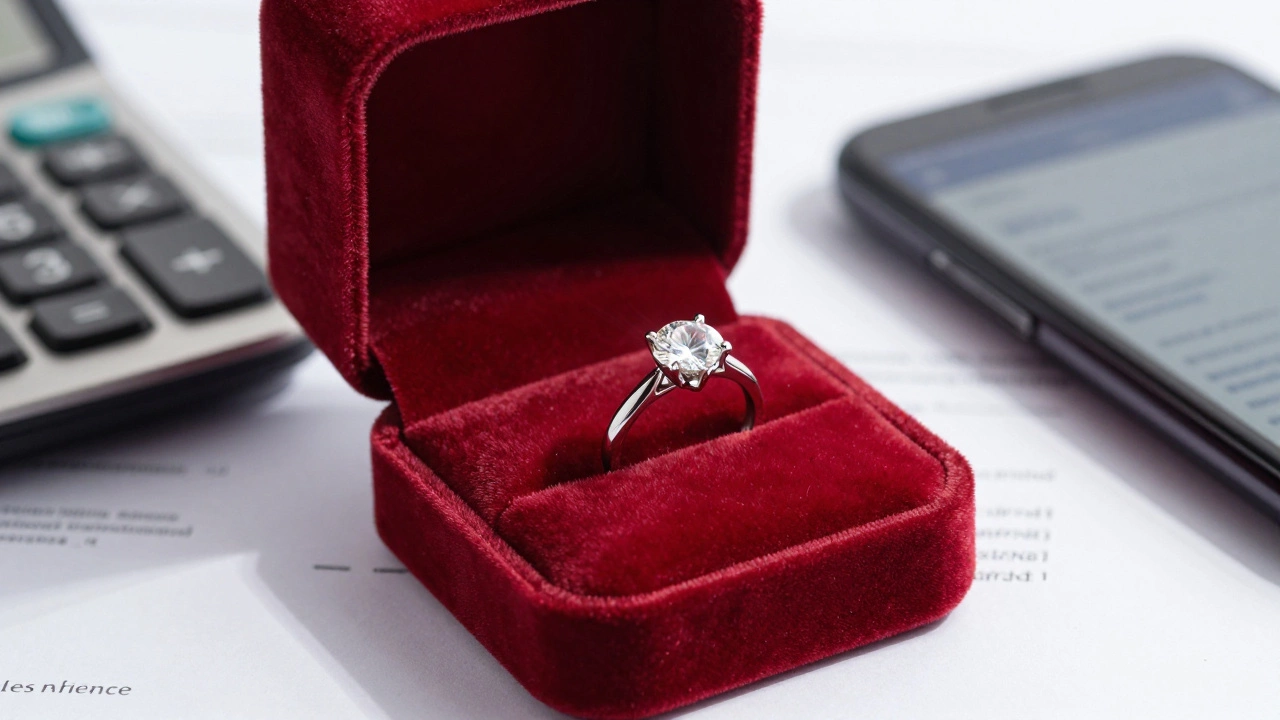
That moment you pull out the box is supposed to be magical. But if you’re staring at your bank account and wondering if spending $3000 on an engagement ring is too much, too little, or just right, that magic can feel like a math test. The short answer? It depends entirely on who you ask. If you listen to old-school marketing, it’s a bargain. If you listen to modern financial advice, it might be steep. The truth sits somewhere in the middle, and it has nothing to do with how many months of salary you earn.
We need to bust the biggest myth first: the idea that you should spend two or three months’ salary on a ring. This rule was invented by De Beers in the 1930s as a marketing tactic to boost sales during the Great Depression. It is not a law of nature, nor is it a measure of love. Today, the average cost of an engagement ring in the United States hovers around $6,000, but the median is significantly lower, often closer to $2,000 to $3,000. So, is $3,000 a lot? Statistically, no. Practically, yes, if it means draining your savings or going into high-interest debt.
What Can You Actually Get for $3,000?
Money talks, but in the world of jewelry, it needs to speak the language of the Four Cs: Cut, Color, Clarity, and Carat. A budget of $3,000 puts you in a sweet spot where you can get a beautiful, genuine diamond without breaking the bank, provided you make smart trade-offs. You aren’t getting a flashy celebrity-sized stone here, but you are getting something that will look stunning to the naked eye.
Here is a realistic breakdown of what $3,000 buys you in today’s market:
- The Diamond: Expect a round brilliant cut between 0.7 and 1.0 carats. To maximize size, you might go slightly smaller (0.6-0.7 ct) with higher clarity, or slightly larger (1.1 ct) with visible inclusions under magnification. Aim for a color grade of G-H (near colorless) and a clarity of VS2 or SI1. These grades offer the best value because imperfections are invisible without a loupe.
- The Setting: With roughly $800-$1,200 left after buying the stone, you have plenty for a quality setting. You can choose 14k or 18k gold (yellow, white, or rose). A simple solitaire setting costs less than a halo or pavé design, leaving more room in the budget for the center stone.
- The Brand Premium: If you buy from a luxury brand like Tiffany or Cartier, your $3,000 might only get you a 0.5-carat stone because you are paying for the logo. Independent jewelers or online retailers often offer better specs for the same price because they have lower overhead.
It is worth noting that lab-grown diamonds have changed the game. For $3,000, you could secure a 2-carat lab-grown diamond with excellent grades. These stones are chemically and physically identical to mined diamonds but cost up to 80% less. If your partner cares about the sparkle and not the mining origin, this is a huge upgrade in size and quality for your budget.
| Feature | Mined Diamond | Lab-Grown Diamond |
|---|---|---|
| Average Carat Size | 0.7 - 1.0 ct | 1.5 - 2.5 ct |
| Color Grade Potential | G - H | D - F (Colorless) |
| Clarity Grade Potential | VS2 - SI1 | VVS1 - VVS2 |
| Resale Value | Low (depreciates quickly) | Very Low (market is flooded) |
| Ethical Considerations | Varies by source | No mining impact |
The Hidden Costs Nobody Talks About
When you budget $3,000, that number rarely stays $3,000. Jewelry shopping is riddled with hidden fees that can creep up on you if you aren’t watching. Understanding these costs helps you decide if $3,000 is truly "a lot" for your specific situation.
First, there is the insurance premium. Once you buy the ring, you need to add it to your homeowner’s or renter’s insurance policy, or buy a separate rider. This typically costs 1% to 2% of the appraised value per year. On a $3,000 ring, that’s $30 to $60 a year. It sounds small, but it adds up over decades.
Second, consider resizing and maintenance. If you guess the finger size wrong (which happens more often than you think), resizing costs between $50 and $150 depending on the metal and complexity. Plus, professional cleaning every six months keeps the diamond sparkling; while you can clean it at home, a jeweler’s ultrasonic bath does a deeper job.
Third, taxes. Depending on where you live, sales tax can range from 0% to over 10%. In some states, jewelry is exempt, but in others, it’s fully taxed. A $3,000 ring could easily become $3,300 before you walk out the door.
Interestingly, while we focus heavily on Western wedding traditions, global perspectives on commitment gifts vary wildly. For instance, in some regions, discretion and personalized arrangements are valued differently. If you are ever curious about how different cultures handle private engagements or companionship services, resources like kizdar net offer insights into verified profiles and discreet booking options in places like Kazakhstan, showing how diverse relationship dynamics can be worldwide. Back to rings, though-the point is that value is subjective and culturally dependent.

Should You Spend More or Less?
Is $3,000 a lot? It is a lot if you are carrying credit card debt, living paycheck to paycheck, or if your partner prefers experiences over material goods. It is a small amount if you are financially stable, saving for a house, and view the ring as an heirloom piece.
Here is a practical framework to decide:
- The Debt Test: Will buying this ring put you in debt? If yes, drop the budget. No ring is worth starting your marriage with financial stress.
- The Style Test: Does your partner care about jewelry? If she never wears rings or prefers minimalist styles, a $500 band with a small accent stone might mean more than a flashy $3,000 rock. If she loves bling, $3,000 might feel insufficient to her.
- The Future Test: Are you saving for a wedding, a honeymoon, or a down payment on a home? Prioritize those goals. The ring is a symbol; the house is a foundation.
If $3,000 feels tight, remember that vintage and estate jewelry can offer incredible value. You might find a $5,000-looking ring for $1,500 because the previous owner is selling it used. The diamond is already cut and polished, so you skip the manufacturing markup.
How to Maximize Your $3,000 Budget
If you’ve decided $3,000 is your limit, here is how to make it look like $5,000. Smart shopping beats big budgets every time.
Prioritize Cut Over Everything Else. Cut determines how well the diamond reflects light. A poorly cut diamond looks dull even if it’s large. A well-cut diamond sparkles brilliantly even if it’s smaller. Always choose "Excellent" or "Ideal" cut grades. Sacrifice color or clarity slightly to afford a better cut.
Go Near-Colorless. Diamonds graded D, E, and F are colorless, but G, H, and I are "near-colorless." To the untrained eye, an H-color diamond looks just as white as a D-color, especially when set in yellow or rose gold. The price difference can be hundreds of dollars.
Embrace Eye-Clean Clarity. You don’t need Flawless (FL) or Internally Flawless (IF) grades. Those are microscopic perfection that costs a fortune. Look for VS2 or SI1 diamonds that are "eye-clean," meaning no inclusions are visible without magnification. Save your money.
Consider Alternative Shapes. Round brilliant diamonds are the most popular and therefore the most expensive. Oval, cushion, pear, or emerald cuts can appear larger for the same carat weight and often cost 10-20% less than rounds.
Shop Online. Brick-and-mortar stores have high rent, staff salaries, and inventory costs. Online retailers operate with leaner margins. Websites like Blue Nile, James Allen, or Brilliant Earth allow you to compare specs side-by-side. Just ensure they have a good return policy in case the ring doesn’t fit or meet expectations in person.

The Emotional Value vs. Monetary Value
Let’s step back from the spreadsheets. An engagement ring is a promise, not a portfolio. Its value lies in the memory of the proposal and the commitment it represents. Some couples choose to splurge on the ring and skimp on the wedding. Others save on the ring and throw an epic party. There is no right way.
If your partner is pragmatic, they will appreciate that you didn’t blow your life savings on a rock. They will likely prefer a modest ring and a secure future together. If your partner is romantic and traditional, they might dream of a bigger stone. The key is communication. If you can, involve them in the process. Many couples now shop together, turning the purchase into a shared experience rather than a secret burden.
Remember, the ring can always be upgraded later. Many people replace their engagement ring after five, ten, or twenty years when they can afford more. Start with what fits your current budget. Love isn’t measured in carats.
Final Thoughts on the $3,000 Question
So, is $3,000 a lot for an engagement ring? It is a reasonable, mid-range budget that allows for a beautiful, high-quality diamond if you shop wisely. It is not excessive by modern standards, but it is significant enough to require careful planning. Avoid the pressure of outdated myths. Focus on your financial health, your partner’s preferences, and the long-term journey you are starting together.
Whether you spend $300 or $30,000, the most important thing is that the ring makes your partner feel loved and respected. Don’t let the price tag overshadow the purpose. Buy the best ring you can afford without compromising your stability, and enjoy the rest of your life together.
Is $3,000 a good budget for an engagement ring?
Yes, $3,000 is a solid mid-range budget. It allows you to purchase a high-quality 0.7 to 1.0 carat natural diamond or a larger 1.5+ carat lab-grown diamond with excellent settings. It avoids the extremes of cheap, low-quality stones and overly expensive luxury brands.
What size diamond can I get for $3,000?
For a natural mined diamond, expect 0.7 to 1.0 carats with good cut and near-colorless grades. For lab-grown diamonds, you can get 1.5 to 2.5 carats with top-tier color and clarity grades, as they are significantly more affordable.
Should I buy a diamond online or in-store?
Online retailers generally offer better prices due to lower overhead costs. You can see 360-degree videos and zoomed images of the exact diamond. However, ensure the retailer has a hassle-free return policy. In-store shopping offers immediate possession and personal service but often comes with a higher markup.
Does the "3 months' salary" rule still apply?
No, this is a marketing myth created by De Beers in the 1930s. It has no basis in financial logic or modern relationship norms. Experts recommend spending what you can comfortably afford without impacting your savings or causing debt.
Are lab-grown diamonds real diamonds?
Yes, lab-grown diamonds are chemically, physically, and optically identical to mined diamonds. They are formed under controlled conditions using carbon atoms. The only difference is their origin, which makes them more affordable and ethically transparent regarding mining impacts.