Engagement Ring Budget Planner
The "Marketing Myth" Cost
Based on the 1930s De Beers rule (3 months salary):
$0
Your Modern Sustainable Budget
Based on your priority and existing savings:
$0
Pro Tip: Using this modern budget instead of the myth allows you to redirect funds toward your wedding, honeymoon, or home down payment.
Value Optimization Tips:
- Prioritize Cut: A better cut makes a smaller diamond look larger.
- Lab-Grown: Save 30-50% for the same visual look.
- Color Hack: G or H grade looks white but costs much less.
Enter your details and click calculate to see the difference between marketing myths and financial reality.
Key Takeaways
- The three-month rule was created by De Beers to increase diamond sales.
- Your budget should be based on your actual financial health, not a fixed formula.
- Value is found in the quality of the stone and your partner's taste, not the price tag.
- Lab-grown diamonds and alternative gemstones offer high luxury without the financial strain.
Where did this "rule" even come from?
To understand why we're still talking about this, we have to look at the De Beers is a global diamond mining and sales company that historically controlled the majority of the world's diamond supply.. Back in the 1930s, diamonds weren't as synonymous with engagement as they are today. De Beers launched a massive advertising campaign to link the size of the diamond directly to the depth of a man's love. By the 1940s, they shifted the narrative to a specific financial benchmark: three months' salary.
It was a brilliant move. They turned a luxury purchase into a social requirement. If you spent less, you were implying your partner wasn't worth the investment. If you spent more, you were a hero. But remember, this wasn't based on economic stability or relationship psychology-it was based on a corporate goal to move more inventory. Today, in a world with soaring rent and student loans, following a 90-year-old corporate script doesn't make much sense.
How to actually set your engagement ring budget
Forget the percentages for a second. A Budget is a financial plan that allocates resources for a specific expense without compromising essential living costs. should be a conversation, not a calculation. When you're figuring out what you can spend on an engagement ring budget, start by looking at your liquid assets. Do you have a dedicated savings account for the wedding? Or are you planning to use a credit card?
A huge mistake people make is ignoring the "after-ring" costs. You aren't just buying a ring; you're likely planning a wedding, a honeymoon, and potentially a down payment on a home. If spending three months of salary means you can't afford a decent venue or you're dipping into your emergency fund, you're creating financial stress at the exact moment your relationship should be celebrating. A more sustainable approach is to set a hard limit that allows you to sleep at night. If that's one month's salary, or just $2,000, that is the "correct" amount for your specific life.
Evaluating value: The 4Cs vs. The Price Tag
When you walk into a jewelry store, the salesperson will talk about the 4Cs is the universal standard for grading the quality of diamonds, consisting of Cut, Color, Clarity, and Carat weight.. This is where you can actually "hack" the budget to get a ring that looks expensive without actually costing three months' pay.
For instance, the Cut is the most important C. A well-cut diamond reflects more light, making it look larger and sparklier than a larger diamond with a poor cut. Similarly, you can often choose a "near colorless" stone (G or H grade) that looks perfectly white to the naked eye but costs significantly less than a Flawless D-grade stone. By prioritizing Cut over Carat, you get more visual impact for every dollar spent.
| Factor | The "3-Month Rule" | The Modern Approach |
|---|---|---|
| Primary Driver | Social Expectation | Personal Financial Health |
| Financial Risk | High (Potential Debt) | Low (Planned Spending) |
| Focus | Carat Size / Price | Style, Ethics, and Quality |
| Diamond Type | Mined Diamonds | Mined, Lab-Grown, or Moissanite |
Exploring alternatives to mined diamonds
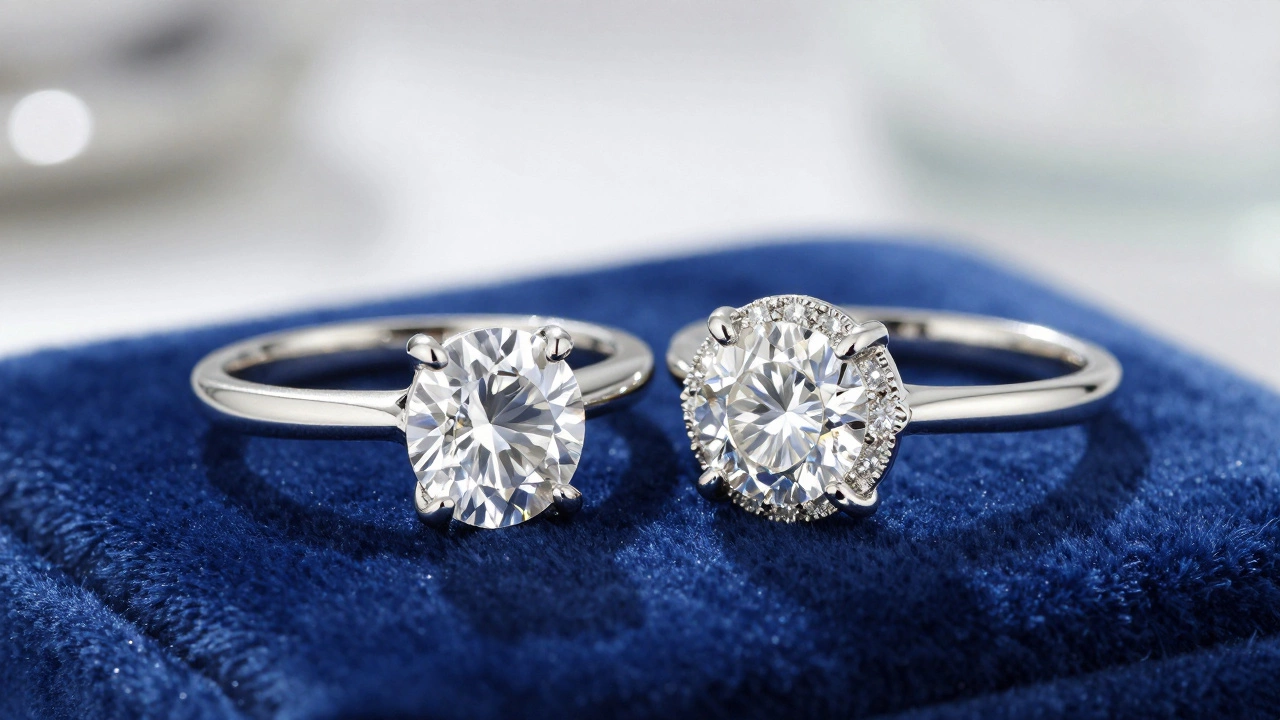
If you want a massive look without the massive price tag, you have a few great options. First, there are Lab-Grown Diamonds is chemically, physically, and optically identical to mined diamonds but created in a controlled laboratory environment.. These are not "fakes"; they are real diamonds. Because the supply chain is shorter and there's no destructive mining involved, they often cost 30% to 50% less than their earth-mined counterparts.
Then there's Moissanite is a silicon carbide mineral that is nearly as hard as diamond and often has more "fire" or brilliance.. It's a fantastic choice for those who want the brilliance of a diamond but prefer to put their money toward a house or a trip to Italy. Choosing an alternative isn't "settling"; it's making a strategic decision about where your money provides the most value.
Common pitfalls to avoid when shopping
One of the biggest traps is the "upgrade" mentality. Many people think they should buy a small ring now and upgrade later. While this is a sweet gesture, it often results in buying two rings instead of one great one. Instead, focus on a timeless Setting is the metal part of the ring that holds the gemstone in place, such as a solitaire, halo, or pavé design.. A classic solitaire setting never goes out of style and allows the stone to be the star.
Another pitfall is ignoring the insurance. Whether you spend $500 or $50,000, a ring is a portable asset that can be lost or stolen. Factor the cost of jewelry insurance into your initial budget. It's a small monthly fee that prevents a total financial disaster if the ring slips off during a swim in the ocean.

The psychological shift: Value vs. Price
Ultimately, the value of an engagement ring isn't found in the receipt. It's a symbol of commitment. When you strip away the marketing, the only thing that actually matters is that the ring reflects your partner's style and your shared values. If your partner values sustainability, a lab-grown stone or a vintage piece is worth more to them than a massive mined diamond bought on credit.
Ask yourself: would your partner rather have a ring that cost three months of your salary, or a ring that cost one month's salary and a honeymoon that you can actually afford to enjoy? Most people will choose the latter. The goal is to start your marriage on a foundation of financial transparency and stability, not with a debt that lingers long after the wedding cake is eaten.
Is the 3-month salary rule still common in 2026?
While some people still mention it, it is far less common and widely viewed as an outdated marketing myth. Most modern couples prioritize their overall financial health and personal preferences over a rigid spending formula.
Will my partner be disappointed if I don't spend 3 months' salary?
This depends entirely on your partner. However, the best way to avoid disappointment is to communicate about styles and expectations before shopping. Many partners prefer a thoughtful, budget-conscious choice over a lavish gift that causes financial strain.
What is a more realistic budget for an engagement ring?
A realistic budget is whatever amount you can comfortably afford without going into high-interest debt. For many, this ranges from a single month's salary to a specific saved amount (e.g., $2,000 - $5,000), regardless of their income level.
Are lab-grown diamonds considered "real" diamonds?
Yes. Lab-grown diamonds have the exact same chemical, physical, and optical properties as mined diamonds. They are not cubic zirconia or moissanite; they are genuine diamonds grown in a lab.
How can I make a smaller diamond look bigger?
You can use a "halo" setting, which surrounds the center stone with smaller diamonds, creating the illusion of a larger stone. Additionally, choosing a thinner band or a square-shaped cut (like a princess cut) can make the diamond appear more prominent on the finger.
Next steps for your ring search
If you're feeling overwhelmed, start by creating a Pinterest board or a shared folder with your partner to identify the styles they actually like. Once you have a visual direction, set a maximum spending limit that doesn't interfere with your monthly bills. Visit a few different jewelers-both traditional and independent-to compare the "look" of different diamond grades in person. You'll likely find that the difference between a "perfect" diamond and a "very good" one is invisible to the eye but costs thousands of dollars more.