Wedding Invitation Postage & Weight Estimator
Select your invitation components below to estimate the total weight of a single suite and see if it might trigger extra postage fees.
Configure Your Suite
Estimated Results
Select options and click calculate to see results.
0g
Postage Analysis
USPS Status:
Australia Post Status:
Recommendation
You just spent three hours picking the perfect font and agonizing over the wording. You hit "order," pay the bill, and wait for the box to arrive. When you open it, something feels off. The card is either flimsy enough to bend in your pocket or so thick it feels like a coaster. Why? Because most people forget about wedding invitation weight.
It’s not just about aesthetics. It’s about money. If your invite is too heavy, you’ll pay extra postage on every single envelope. If it’s too light, it might feel cheap to your guests. The sweet spot exists, but it depends on what kind of vibe you’re going for. Let’s break down exactly how heavy your invites should be, why it matters for your budget, and how to avoid the awkward moment at the post office.
The Standard: What Most Couples Choose
Most standard wedding invitations fall between 100 lb cover stock (approximately 270 gsm) and 120 lb cover stock (325 gsm). This range hits the balance between durability and cost-efficiency. It feels substantial when you hold it, doesn’t flop around in the mail, and usually fits within standard letter-rate postage if kept under one ounce total with the envelope.
Why this specific range? Think of it as the "Goldilocks" zone of paper. Anything below 80 lb (216 gsm) feels like a flyer from a grocery store. Anything above 140 lb (379 gsm) starts requiring hand-canceling at the post office because machines can’t handle the thickness without jamming. For the average couple sending out 100-150 invites, staying in that 100-120 lb window saves hundreds of dollars in unexpected postal surcharges while still looking premium.
| Paper Weight (lb) | Metric Equivalent (gsm) | Feel & Appearance | Postage Implication |
|---|---|---|---|
| 80 lb | 216 gsm | Light, flexible, casual | Standard Letter Rate |
| 100 lb | 270 gsm | Standard, sturdy, professional | Standard Letter Rate (usually) |
| 120 lb | 325 gsm | Luxury, rigid, high-end | May require extra postage |
| 140+ lb | 379+ gsm | Ultra-luxury, board-like | Hand Cancel / Large Envelope Rate |
Understanding GSM vs. Pound Weight
If you’re ordering from an international printer or browsing sites like Zola or Minted, you might see "GSM" instead of "lb." Don’t panic. They measure the same thing: grammage per square meter. Here’s the quick conversion rule of thumb: divide the GSM by roughly 3.5 to get the pound equivalent, though manufacturers vary slightly.
- 200-250 gsm: Roughly 80-90 lb. Good for RSVP cards or inserts where flexibility helps.
- 270-300 gsm: Roughly 100-110 lb. The industry standard for main invites.
- 325-350 gsm: Roughly 120-130 lb. Feels expensive; great for formal weddings.
- 400+ gsm: 140 lb+. Often called "double-thick" or "board." Requires special handling.
Always ask your printer for a physical sample pack before committing. Photos lie. A 120 lb matte finish looks different than a 120 lb glossy finish. Your fingers will tell you what your eyes miss.
The Hidden Cost: How Weight Hits Your Postage Bill
This is where budgets go sideways. In Australia, the US, and many other countries, standard letter postage covers items up to 20mm thick and 50g-100g depending on local rules. Once you add a heavyweight invite, a liner envelope, and a response card, you often cross that threshold.
Let’s do the math for a typical Australian scenario. A standard B5 invite printed on 120 lb paper weighs about 15 grams. Add a matching envelope (10g), a liner (5g), and an RSVP card (8g). That’s 38 grams. Still safe for standard letter rate. But switch to a textured cotton paper? Those fibers are heavier. Add a wax seal? Another 5-10 grams. Suddenly you’re pushing 50g+, which might bump you into the next postage tier.
In the US, the USPS charges extra for "non-machinable" items. If your invite is square (not rectangular), thicker than 0.25 inches, or weighs more than 1 ounce, you pay a surcharge. Multiply that $0.40-$0.80 surcharge by 150 guests, and you’ve lost $60-$120. That’s a nice bottle of champagne or a custom stamp set gone.
When Heavier Is Better (And When It Isn’t)
Do you need 140 lb paper? Only if you want the tactile experience to scream "luxury." Heavyweight paper works best for:
- Formal Black-Tie Weddings: Guests expect rigidity. Floppy paper feels disrespectful to the occasion.
- Foil Stamping or Embossing: Thin paper buckles under heat and pressure. Thick stock holds the design crisp.
- Minimalist Designs: With less ink coverage, the paper texture becomes part of the design. You need substance to carry it.
Conversely, lighter weights shine in:
- Beach or Rustic Weddings: Airy, flowy vibes match thinner, translucent papers.
- Digital-First Couples: If half your guests get emails, don’t overspend on physical copies that sit in drawers.
- Budget-Conscious Plans: Dropping from 120 lb to 100 lb saves ~15% on printing costs and keeps postage standard.
Envelope Pairing: Don’t Forget the Container
Your invite weight means nothing if the envelope collapses. Standard envelopes are made from 24-28 lb bond paper (90-105 gsm). This is thin on purpose-it folds easily and seals well. But if you’re using a 140 lb invite, a standard envelope might tear at the seams when you stuff it.
Look for "heavyweight" envelopes rated for 100+ lb inserts. These use 32-36 lb paper (120-135 gsm). They feel luxurious and protect your investment. Pro tip: Order one full suite (invite + insert + envelope) before buying bulk. Test the fit. Does the invite slide in smoothly? Or does it crinkle? Crinkled edges ruin the unboxing experience.
How to Test Your Own Invite Weight at Home
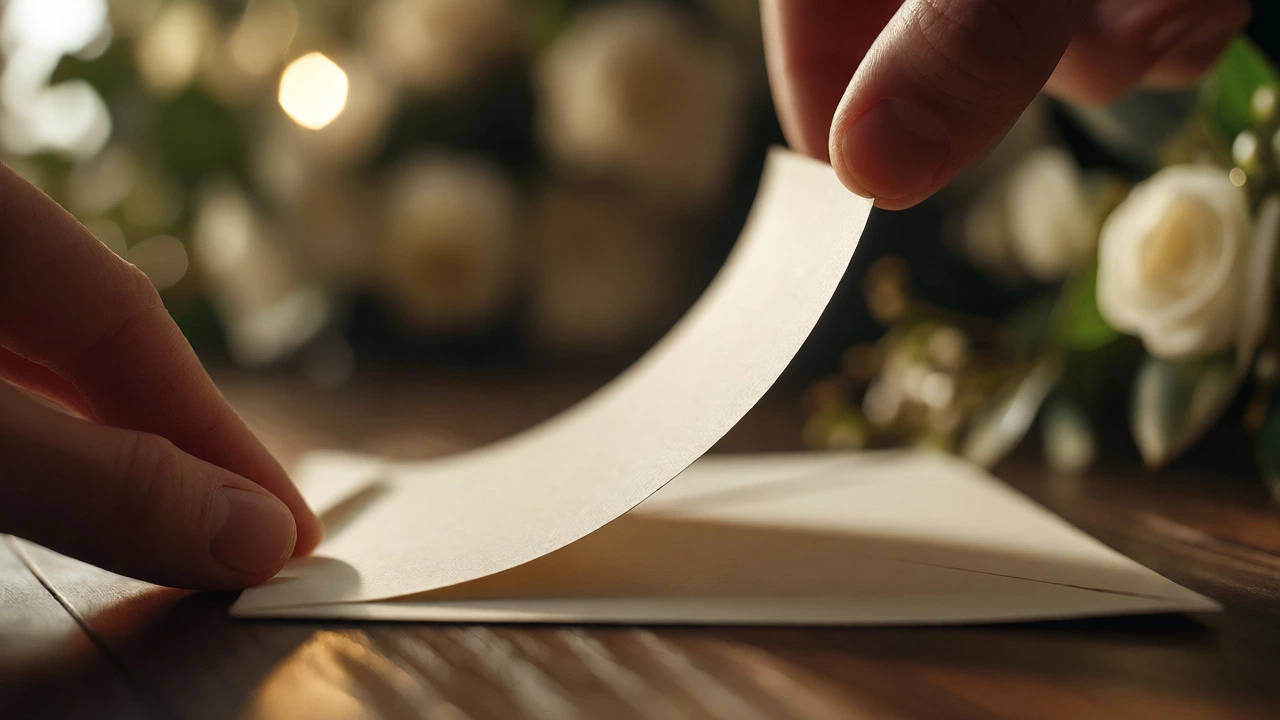
Don’t trust the spec sheet alone. Do the "Bend Test." Hold two opposite corners of your sample card. Try to bend it gently.
- Easy Bend: Too light (<80 lb). Will look cheap.
- Resistant Bend: Perfect (100-120 lb). Snaps back into shape.
- No Bend: Too heavy (>140 lb). Great for luxury, bad for mass mailing.
Also, check the opacity. Hold the card up to a light source. Can you see shadows through it? High-quality wedding paper should block most light unless it’s intentionally translucent vellum. Shadowing makes text hard to read and looks amateurish.
Australia-Specific Postage Tips
Since I’m based in Sydney, I deal with Australia Post daily. Here’s the reality: Australia Post’s standard letter size limit is strict. If your invite suite exceeds 20mm in thickness, it’s no longer a "letter." It becomes a "large letter," which costs more.
To stay within standard rates:
- Keep the total stack under 50g if possible.
- Avoid square envelopes if you can; they often trigger non-standard sorting fees.
- Use self-sealing strips rather than glue flaps, which add bulk and moisture risk.
- Weigh one completed suite on a kitchen scale. If it’s near 50g, assume all suites will exceed due to minor variations.
For 2026, Australia Post has adjusted rates for lightweight items. Always check their current tariff sheet before finalizing your print run. Prices fluctuate annually.
What is the most common wedding invitation weight?
The most common weight is 100 lb cover stock (approx. 270 gsm). It offers a good balance of sturdiness and affordability, fitting within standard postage limits in most countries while feeling premium to the recipient.
Does heavier paper cost more to mail?
Yes, potentially. While the paper itself adds weight, the real cost driver is thickness and rigidity. Items over 1 oz (US) or exceeding size/thickness limits (Australia) may require additional postage or hand-canceling services, adding $0.40-$1.00 per piece.
Is 120 lb paper too heavy for wedding invites?
No, 120 lb (325 gsm) is considered high-end but manageable. It provides a luxurious feel without necessarily triggering non-machinable surcharges, provided the envelope isn't overly bulky and the total weight stays within postal limits.
What is GSM in wedding invitations?
GSM stands for Grams per Square Meter. It measures paper density. Higher GSM means thicker, heavier paper. 270 GSM is standard, while 350+ GSM indicates luxury heavyweight stock.
Can I use thin paper for my wedding invites?
You can, but it risks looking cheap unless done intentionally. Thin paper (under 200 GSM) works well for minimalist designs or if paired with a thick backing card. Otherwise, it may wrinkle easily during transit.