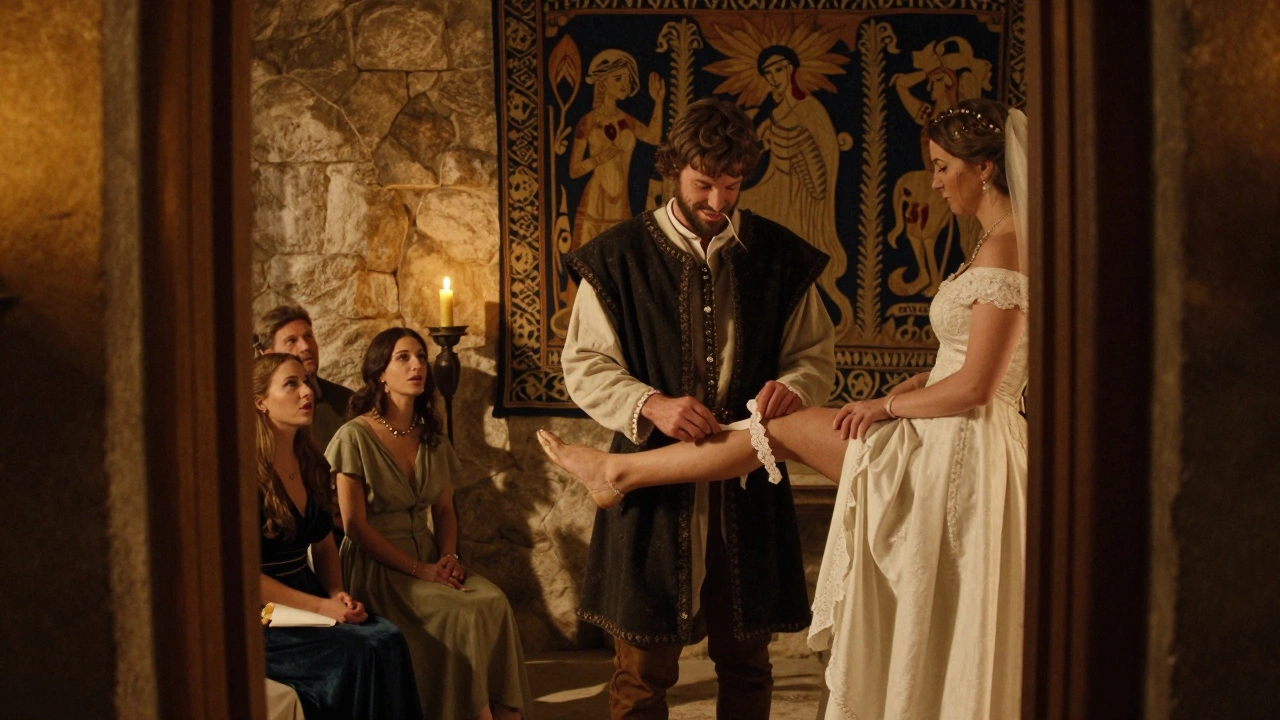
Ever watched a wedding reception and wondered why the groom uses his teeth to take off the bride’s garter? It’s awkward, funny, and a little wild-but it’s not random. This tradition has roots stretching back centuries, and while it’s changed a lot, the core reason hasn’t. It’s not about being cheeky. It’s about proof.
It Started as a Symbol of Proof
In medieval Europe, weddings weren’t just celebrations-they were legal and social contracts. After the ceremony, guests would rush the bride to get a piece of her clothing as a lucky charm. It got so bad that brides started wearing garters they could easily remove and hand out. But the groom’s garter? That was different.
Back then, the groom was expected to prove he’d consummated the marriage. Why? Because marriages were often arranged, and families needed confirmation the union was real. Removing the garter with teeth became a theatrical way to show the crowd that the groom had been intimate with the bride. It wasn’t about sex appeal-it was about social validation. The garter was a physical token, and the way it was taken signaled the marriage was official.
From Proof to Performance
By the 1800s, the garter removal had lost its legal weight but kept its drama. It became a party trick, a way to keep guests entertained after dinner. The groom would pull the garter off the bride’s leg, often with his hands at first, then slowly started using his mouth for more flair. The teeth made it look more daring, more playful, and more memorable. It turned a private moment into public theater.
By the 1950s, Hollywood and TV weddings cemented the image: groom on one knee, garter in mouth, crowd cheering. The act became less about proving anything and more about creating a photo op. That’s when the garter toss began-throwing the garter to single male guests as a playful twist on the old luck ritual.
Why Teeth? Not Hands?
You might ask: why use teeth instead of just pulling it off with hands? The answer is symbolism and spectacle. Hands are practical. Teeth are intimate. Teeth imply closeness, vulnerability, even a hint of passion. It’s a visual shorthand for the physical connection between the couple.
Think of it like kissing at the altar-it’s not about the act itself, but what it represents. The teeth make the moment feel more personal, more raw, more real. It’s also harder to do well. That’s why it sticks in people’s minds. A hand removal? Quick, clean, forgettable. A garter pulled off with teeth? That’s the moment the DJ cuts the music and everyone leans in.
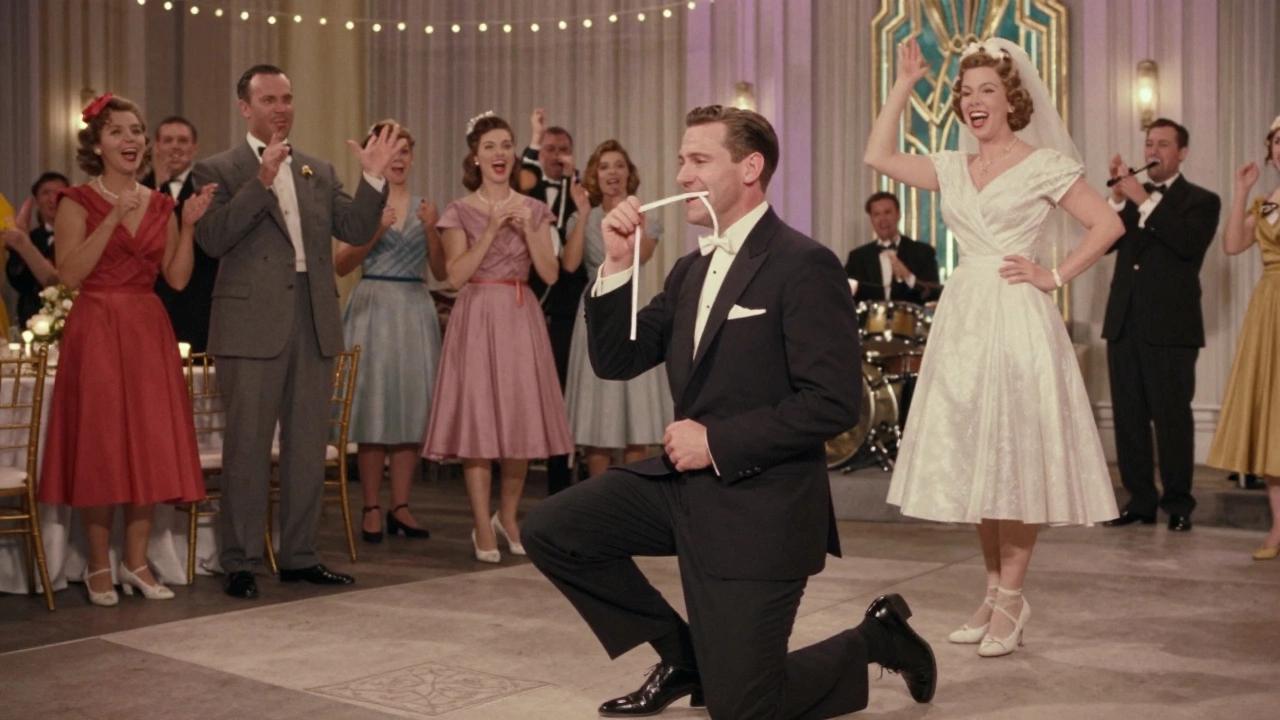
Modern Versions: Still Alive, But Changing
Today, not every groom does the teeth thing. Many opt for a simple hand removal, especially if the bride or guests are uncomfortable. Some couples skip it entirely. Others turn it into a joke-groom uses tweezers, or the bride removes her own garter and hands it to him.
But in places like the U.S., Canada, and parts of Australia, the teeth version still pops up at traditional receptions. It’s not about shock value anymore. It’s about honoring a ritual that’s lasted 500 years. Even when people don’t know the history, they feel its weight. It’s one of those things that feels right because it’s always been done that way.
What About the Garter Toss?
The garter toss is the next act in this tradition. After the removal, the groom stands with the garter and tosses it over his shoulder to a crowd of single men. The man who catches it is said to be the next to marry.
It’s a direct descendant of the old custom where guests would grab pieces of the bride’s clothing. The garter was the groom’s piece of the puzzle. Catching it meant you were next in line for love-or at least, that’s what people hoped.
Today, many couples skip the toss too. Some find it outdated. Others replace it with a bouquet toss for all guests, regardless of gender. But if you’re keeping the garter removal, the toss usually comes right after. It’s the full package: removal, toss, laughter, and a little bit of superstition.
Is It Still Appropriate?
That’s the big question. Some people think the garter removal is sexist, objectifying, or too sexual for a family event. And honestly? They’re not wrong. If the bride isn’t comfortable, it shouldn’t happen. No tradition is sacred if it makes someone feel exposed.
But here’s the thing: traditions evolve. The teeth thing didn’t start as a joke-it started as proof. Today, it’s a choice. Many couples now make it a consensual, lighthearted moment. The bride might even help guide the groom’s hands-or laugh as he pretends to use his teeth while actually using his fingers.
There’s no rule that says you have to do it. But if you do, make sure it’s fun for everyone. Not just the groom. Not just the crowd. The bride too.

Alternatives That Still Feel Meaningful
If the teeth thing doesn’t fit your vibe, here are a few modern twists:
- Hand removal with a ribbon - Use a decorative ribbon instead of lace. The groom pulls it gently. No teeth, no drama.
- Joint removal - The bride helps the groom take it off. A shared moment instead of a performance.
- Gift exchange - The groom gives the bride a small gift (a locket, a note) in exchange for the garter. Symbolic, sweet, no audience pressure.
- Remove and donate - The garter is given to a charity auction or donated to a bridal reuse program. Keeps the ritual but adds meaning.
- Skip it - Seriously. You don’t need it. Your wedding doesn’t need to check every box from the 1600s.
What the Bride Should Know
If you’re the bride, you have all the power here. You can say yes, no, or change it. You don’t owe anyone a spectacle. If you’re nervous, talk to your partner ahead of time. Tell him how you feel. Maybe you’d rather he just pulls it off with his hands. Maybe you want to wear two garters-one for the removal, one to keep.
Many brides today wear a "keeping" garter and a "tossing" garter. The first is the one they’ll save. The second is the one the groom removes. It’s practical, sentimental, and takes the pressure off.
And if you’re the groom? Don’t feel like you have to perform. The tradition isn’t about your skill. It’s about your connection. A gentle, quiet moment can mean more than a flashy act.
Final Thought: It’s About Connection, Not Performance
The garter isn’t magic. The teeth aren’t sacred. The tradition didn’t survive because it was sexy-it survived because it was human. It turned a private moment into a shared one. It gave people something to laugh about, to remember, to talk about for years.
Today, you get to decide what that moment means. You can keep the teeth, ditch them, or turn them into something new. The only rule that matters? Make it yours.
Why do garters have two layers?
Many brides wear two garters: one as a keepsake (usually more decorative or sentimental) and one specifically for the removal and toss (often simpler and easier to remove). This lets the bride keep the meaningful one while still participating in the tradition.
Is the garter removal only for heterosexual weddings?
No. Same-sex couples often adapt the tradition in creative ways-like removing a garter from the partner’s leg, or even swapping garters between both partners. The ritual is about celebration, not gender roles.
Can the bride remove the garter herself?
Absolutely. Many brides choose to remove their own garter and hand it to the groom. This flips the script and makes the moment more collaborative and less performative.
What if someone in the crowd is uncomfortable?
Talk to your planner or DJ ahead of time. You can announce it as "optional," skip the public removal, or do it behind closed doors. No one should feel pressured to watch something they’re not comfortable with.
Do garters still have any real luck meaning today?
Not really. The idea that catching the garter means you’ll marry next is just folklore. But if it makes someone smile or feel included, that’s its own kind of luck.